How Water4All is bridging the gap between research, policy, and operations at the Euro-Mediterranean Water Forum
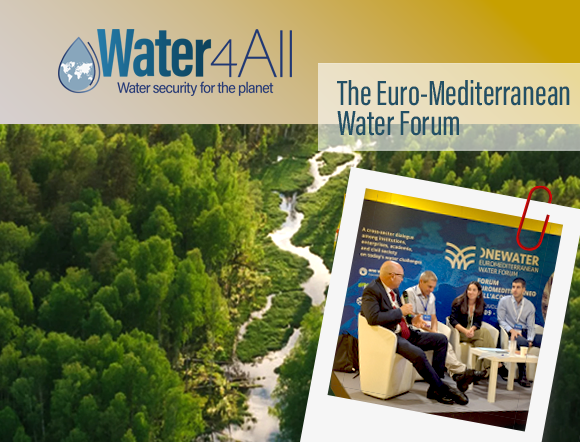
From September 29 to October 2, 2026, the Euro-Mediterranean Water Forum (EMWF) took place in Rome (Italy). This high-level international gathering brought together delegates, ministers, scientific institutions, and industry leaders from over 40 countries across the Mediterranean, Europe, and the Middle East to tackle one of the defining crises of our era: water security in the face of accelerating climate change.
The Water4All partnership had the honour to actively join this major event, showcasing how international cooperation and research alignment can turn climate risks into concrete resilience strategies.
A high-level platform for Mediterranean water security
This Forum serves as a key international platform for dialogue and cooperation dedicated to sustainable water management and water security across Europe and its neighbouring regions. Over four days, the forum focused on practical solutions, policy alignment, and technological innovation structured around four core pillars:
- Climate Resilience and Resource Protection,
- Digital Transformation and Infrastructure,
- Cross-Border Cooperation, and
- Financing the Transition
Water4All was closely involved through its partners, including ISPRA, Water Europe and INBO, who brought the partnership’s experience into dedicated side events, such as:"The Resilience Advantage: Leading Through Water Risk" / "Governance: a key role for Water resilient River basins"
Bridging the gap: where does innovation get lost?
On October 1, the workshop "The Resilience Advantage: Leading Through Water Risk", brought together Italian and Dutch water leaders to explore proactive strategies under accelerating climate risks. It was organised by the Embassy and Consulate General of the Netherlands.
Representing the Water4All partnership, Alessandro Lotti (ISPRA) took part in this session alongside international experts and decision-makers. The session explored how water leaders can anticipate risks, prioritise actions, and build long-term resilience before disruption strikes.
During the debate, Alessandro Lotti highlighted the concept of “alignment” promoted by Water4All, a core effort aimed at filling the gap between scientific research, public policy, and operational management on the ground. He brought to the table a crucial question for the entire water sector: “Where does innovation get lost between the laboratory, the ministry, and the utility?”
Water4All plays a pivotal role in answering this challenge by:
- Aligning scientific research agendas with the practical needs of the water sector to manage risks and create sustainable value.
- Supporting decision-makers with evidence-based solutions for resilient river basin governance.
- Ensuring that innovative tools and knowledge transition effectively from laboratories into public policy and practical operations by water utilities.
Fostering basin-scale water resilience
During another session dedicated to the role of governance for water resilience, moderated by INBO, Andrea Rubini (Water Europe) emphasized how European research and innovation directly support river basin authorities. A core component of this approach under Water4All relies on its network of Water-Oriented Living Labs across Europe, enabling public authorities, businesses, researchers, and local communities to co-create and test governance tools directly within their catchments before scaling them up across territories.
The Júcar River Basin Authority (CHJ), an external partner involved in Water4All science-policy activities, detailed how transparent monitoring platforms, clear allocation rules and public engagement in River Basin Management Plans (RBMPs) drive day-to-day resilience.
By acting as a strategic bridge between researchers, policymakers, and operators, and supporting innovative practices in living labs, Water4All continues to drive systemic change and foster a water-secure future across Europe and the Mediterranean.
More information: