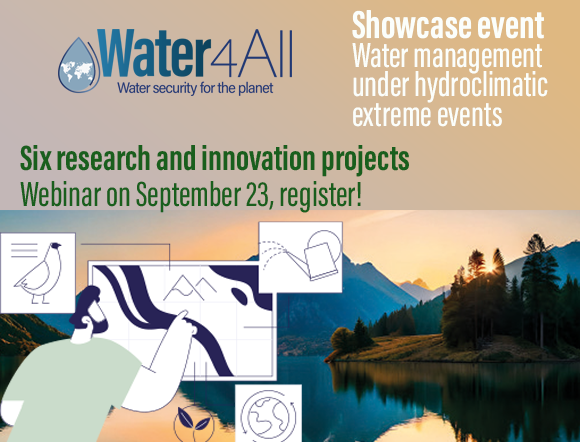
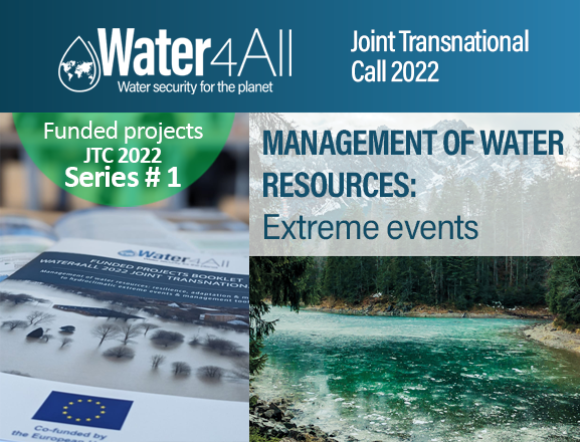
Water4All’s 2022 Joint Transnational Call sought to deliver knowledge, models, approaches, tools and methodologies to better understand hydrological processes at different scales and to respond more efficiently to emerging water issues related to extreme events.
This Call also addressed innovative governance models, and enhanced participation of stakeholders, communities and society at large in water management issues related to extreme events.
The increased number of hydrological extreme events in the last few decades has motivated the research community to investigate their spatial variability and underlying
processes. Evidence suggests that to properly support water management and tackle future and emerging challenges, it is necessary to make progress in understanding the spatiotemporal complex systems that drive hydrological events.
Today, a series of portraits of the 27 excellent R&D projects selected for funding begins. An introduction to the three following projects: AQUIGROW, CLIMEX-EX and DATASET. The abstract for each project is available in the booklet here
AQUIGROW project
The Aquigrow scientific research project is focused on “sustainable aquifer recharge to enhance the resilience of groundwater services under increased drought risk.”
The general objectives of this project rely on
- quantify current recharge fluxes in several study aquifers used for irrigation and/or drinking water supply in Europe, Israel and South Africa;
- identify critical issues in the sustainable management of these aquifers, both in terms of water quantity and quality, related to current practices, planned land use changes and predicted climate change scenarios;
- develop numerical tools and management solutions to improve recharge fluxes and their quality, increase available groundwater storage and preserve its use, especially during drought.
CLIMEX-PE project
The project is focused on “Climate Extremes buffering through groundwater flow-based managed aquifer recharge and public engagement”
Indeed, the principal water reserves are in the aquifers, as groundwater. The connection of groundwater to surface water bodies and ecosystems makes these reserves vulnerable to extreme events, but they can also buffer the effects of hydrological extremities.
The main goal of the CLIMEX-PE project is to incorporate groundwater flow system evaluation, local scale MAR (Managed Aquifer Recharge) techniques, and co-creative public engagement, providing a new and upscaled nature-based MAR (NB-MAR) approach for regional scale mitigation of extreme hydroclimatic events
The general objectives are to display
- the influence of natural extremes on groundwater,
- the application of NB-MAR to buffer climate events,
- the impacts on groundwater quantity/quality,
- the workflow for the involvement of the NB-MAR in society engagement, communication, education,
- the consideration of groundwater flow systems and their replenishment with excess water in decision-making,
- the integration of NB-MAR to water policies and develop a sustainable regulatory environment.
Website: CLIMEX-PE (elte.hu)
DATASET project
The project is focused on "groundwater salinization and leaching assessment tool: a holistic approach for coastal areas".
The overall goal of DATASET is to develop an efficient tool to assist in the protection and regulation of water resource use and management in coastal aquifers. To do so DATASET aims to achieve the following objectives:
- Develop and apply a method to create vulnerability maps throughout a holistic assessment of coastal aquifers coupling the evaluation of agricultural leaching and salinization processes in a single methodology to improve water governance aimed at early warning, prevention, and mitigation of groundwater quality degradation in the present and future conditions, accounting for impacts of climate change and hydroclimatic extreme events.
- Promote a paradigm shift in water management, through internet access to data and models, dissemination of management tools for planning and societal implication and their transfer to stakeholders.
- Promote social awareness on the importance of groundwater and its sensitivity to climate change and hydroclimatic extreme events from stakeholders and decision makers to end users.