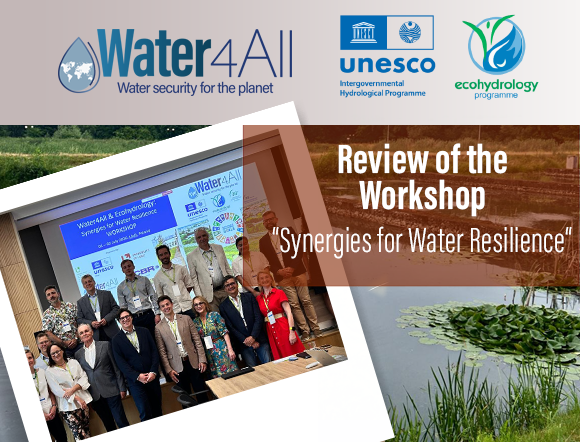
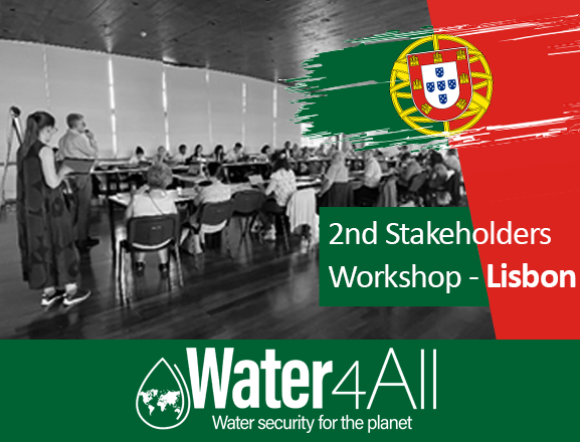
Update - The stakeholder workshop held in early June, on strategic orientations of the programme, gathered around 40 participants to talk about the use of digital tools in water management.
27 stakeholders and 14 members of the Water4All consortium took part in the debate which offered a better understanding of
- Drivers and barriers to the use of digital tools in water management.
- Current trends in the development of these tools.
- Data management considerations.
- Capacity building issues for enhancing the use and usefulness of digital tools.
For the workshop, Water4All partners strived to bring representatives of academia, the innovation sector and water users (e.g. water utilities, and water management authorities) to have different perspectives and to enable communication between “problem owners” and “solution providers”.
The inputs provided will be instrumental in the update of Water4All’s strategic agenda, due by the end of 2025.
Digital tools: positive aspects & possible risks
Discussions showed that digital tools allow the optimization of the decision-making process through a better understanding of complex systems. However, their use is often limited because of capacity-building issues, the need for organizational paradigm changes and data management requirements (in particular when it comes to data ownership and data security). Even though accessibility is improving, data is still fragmented and quality is not at its highest standard. Furthermore, there is a need to enhance data interoperability as different formats, scales and languages are currently in place.
Knowledge gaps
The last part of the workshop was dedicated to the identification of knowledge gaps. The need for better monitoring of water needs for different uses, notably through remote sensing, was highlighted by participants as well as the need for standardization and data sharing, the integration of socioeconomic parameters in integrated models, and the analysis of digital tools in the monitoring and valuation of ecosystem services. Lastly, it was pointed out that Water4All should come up with strategies to increase the transferability of models and improve end-users’ acceptance of digital tools.
The proceedings of the workshop will be available soon.
______
May 2024
As part of the update process of the Water4All’s strategic research and innovation agenda, Pillar A is currently organizing a stakeholder consultative workshop.
The workshop will be held in Lisbon, back-to-back to the IAHR Conference (www.iahr2024.lnec.pt), on the 3rd and 4th June 2024.
This is the second of a series of two workshops planned by the consortium. It will offer an excellent opportunity to get more insights into the applications and potential barriers for the roll-out of digital tools for water management.
It will gather R&I experts in digital tools as well as representatives of water management authorities to develop a clear picture of the benefits of digital tools in securing smart management of water resources, the data needed for the provision of those services and the main limitations when it comes to the wide use of tools.
The workshop will be organised into different discussion blocks. Each block will be introduced by two to three inspiring presentations that will set the ground for deeper discussions.
The outputs of this workshop will be instrumental in the development of the second version of the strategic agenda, which will be published at the end of 2025.
If you are an expert in digital tools for water management and/or a representative of a water management authority, do not hesitate to contact the Water4All Partnership for due consideration in the selection of experts at: water4allcommunication[at]agencerecherche.fr
Digital tools have been identified in Water4All’s strategic agenda as one of the enablers or elements that will support the activities of the programme. Digital tools are evolving rapidly and the strong modelisation, data collection and monitoring capacities of these tools must be seized by Water4All to enhance efficiency, effectiveness and sustainability in the management and conservation of water resources.