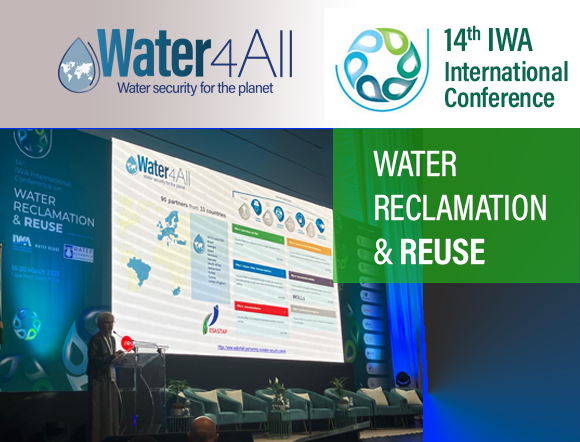
Water4All was present at the IWA Water Reclamation and Reuse 2025. This biennial event is organised by the Water Reuse Specialist Group of the IWA International Water Association.
The biennal gathered around 750 participants from five continents. Link here
Key topics
The key topics of this conference included risk assessment, urban reuse, and potable water reuse, the focus of LNEC’s presentation. In addition to the scientific results on direct potable reuse for building the social trust in water reuse safety, Maria João Rosa (LNEC) highlighted the Water4All EU partnership objectives and strategy, and the Water-Oriented Living Labs (WOLL) role, as illustrated for the Lisbon WOLL.
Session on "potable water reuse" of the Lisbon WOLL
The session on Tuesday, April 18, 2025, called “Pilot-scale studies of advanced wastewater treatment for direct potable water reuse for beer production”, was a demonstration of the work done on a concrete example, showing its feasibility and explaining the process.
Focus on the Lisbon Water Smart Living Lab (WOLL)The Lisbon WOLL innovation actions included a pilot demonstration of water reclamation for artisanal beer production to provide scientific evidence on the safety of direct potable reuse in industry. It was established in the scope of the B-WaterSmart project (2020-2024) (Link here) with a strong focus on water reuse. It continues after 2024 as a water-oriented living lab (WOLL) of the Water4All “Atlas of EU WOLLs”. Link here Objectives:
The Beirolas Water Resource Recovery Facility, in Portugal: The demonstration took place at the Portuguese Beirolas Water Resource Recovery Facility (WRRF). It is one of the biggest in Portugal, designed for 213,510 population equivalent, comprising anaerobic/anoxic/oxic activated sludge treatment and sand filtration, and receiving urban and industrial wastewater (predominantly domestic) from a combined sewer system in Loures and Lisbon municipalities. Four advanced treatment technologies were pilot-tested
Aiming at comparing different RO-based reclamation schemes towards water quality and operational performance, four different treatment schemes were continuously piloted. Once per treatment scheme, it was analysed for trace compounds (microbial and chemical contaminants). They all produced water with an adequate quality to be reused in the beverage industry, complying with the EU and the Portuguese drinking water quality standards. |