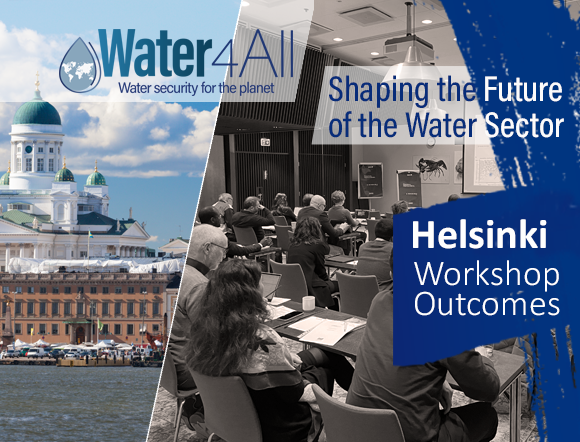
As part of the activities for the update of its Strategic Research and Innovation Agenda (SRIA), Water4All held its foresight workshop in Helsinki (Finland) on the 15th and 16th January. The workshop brought together leading water experts to discuss trends and drivers shaping the future of water-related research and innovation at European and global levels.
The workshop gathered 25 water specialists
The Water4All Foresight workshop brought together experts for dynamic and engaging discussions, aiming at creating a joint vision for the future of water sector and giving input to the upcoming update of Water4All Strategic Research and Innovation Agenda.
The Future Wheel technique
A key feature of the workshop was the use of the Future Wheel technique, a foresight method well-suited for exploring the cascading impacts of potential disruptors. This method encourages participants to map out primary, secondary, and tertiary consequences of major trends and events, fostering a deeper understanding of interconnected challenges and opportunities.
The workshop identified critical disruptors such as climate change, geopolitical tensions, technological advancements, and challenges like water scarcity, pollution, and declining groundwater quality. The Future Wheel helped participants visualize the far-reaching implications of these issues, emphasizing how they influence ecosystems, societies, and economies in complex ways.
Actionable opportunities
While many scenarios painted a concerning picture of increasing variability and uncertainty—especially regarding geopolitical instability and disruptions to water systems—there was also a focus on actionable opportunities. Discussions revealed differences in emphasis among groups, such as varying attention to financing, biodiversity, agriculture, and the role of human behavior versus environmental impacts. Some groups prioritized processes within human control, like technological innovation, while others highlighted external forces such as climate or geopolitical-driven disruptions.
Despite these differences, participants universally stressed the importance of interdisciplinary collaboration, integrating marginalized voices, and fostering resilience through capacity building and inclusive governance. Turning risks into opportunities through evidence-based policymaking, improved risk management, and innovative solutions emerged as a central theme.