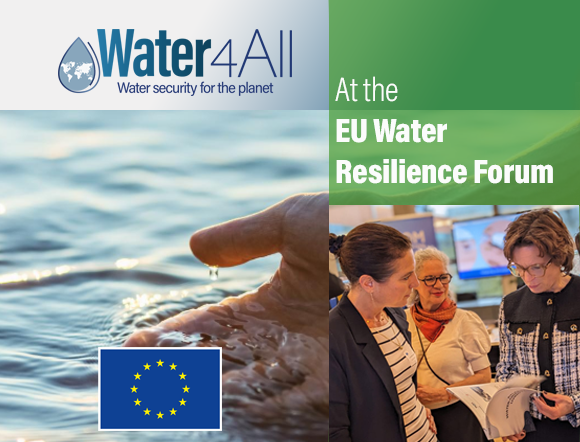
Water4All was invited to participate in the first EU Water Resilience Forum on December 8. This first event followed the adoption of the European Water Resilience Strategy on May 7, 2025. During this day, the team present on the booth could exchange with Jessika Roswall, and other visitors eager to learn more about the Water4All Partnership and its activities.
This forum was organised by the European Commission in collaboration with the European Economic and Social Committee (EESC) and the Committee of the Regions (CoR). It featured high-level participation from:
- Jessika Roswall, Commissioner for the Environment, Water Resilience and a Competitive Circular Economy
- Kata Tüttő, President of the CoR
- Séamus Boland, President of the EESC
Watch an extract of the EU Water Resilience Forum: High-Level Opening Session & Key Leaders Speak | Europe
Parallel breakout sessions
The forum tackled water challenges head-on through dedicated sessions on different aspects to build the water-secure Europe by 2050, for instance:
- financing innovative water solutions,
- strengthening industrial competitiveness through water resilience,
- scaling water efficiency from local to global action.
- urban water challenges,
- digital transformation opportunities,
- upskilling initiatives
Session dedicated to Digital Transformation for Water Management
Digital tools and Water4All: Gaetane Suzenet1 had the opportunity to talk during this session about digital tools through Water4All, one of Europe’s most ambitious partnerships.
She explained that:
- Water4All is a European effort to have a large vision with the digitalisation, which is one of the key enablers for water management today.
- Innovation is flourishing, but that scaling is stuck: “The real challenge is scaling. We are brilliant at pilots… and much slower at deployment.”
Three main ideas are to be considered according to her:
- The data problem must be fixed, as digital innovation depends on it. Water4All is building a FAIR data ecosystem (Findable, Accessible, Interoperable and Reusable) with a Data Sharing Facility, so project data can be easily found and reused. Best-practice recommendations to prepare for a European water data space aligned with FAIR principles are being developed.
- Trust must be built through evidence. But to scale, this evidence needs to be shared, recognised, and comparable.
- Regulation, incentives and investment must be aligned. Different aspects are needed:
- Regulation that rewards digitalisation.
- Digital tools enable performance-based models where we pay for outcomes, not equipment.
- Funding that goes beyond research
- Treating digitalisation as infrastructure ensures that it is funded, maintained, and scaled with the same priority as traditional water systems.
Water resilience in Europe depends as much on digital infrastructure as it does on physical infrastructure.The climate is changing faster than our water systems were ever designed to handle. But digital innovation gives us something profoundly powerful: the ability to anticipate, to adapt, and to act before crises unfold.
__
1 - Gaetane Suzenet: President and Co-Founder of the European Water Tech Accelerator, and Vice Chair of the Water4All Scientific and Technological Board