
- :
What is a WOLL?
A Water-Oriented Living Lab (WOLL) is a real-life “field lab” and open-innovation ecosystem where water solutions are co-created, tested, validated and implemented in real settings, with multi-stakeholder governance (quadruple helix: public sector, industry, academia, civil society).
| Wolls are built on a shared set of principles: | |
|
|
In Water Europe’s framing, WOLLs combine the testing of technologies with integration approaches, business models and innovative policies, creating tangible value for territories and stakeholders.
Context“Demonstration of innovation” (Action pillar D) plays a foundational role within the Water4All Partnership, serving as the cornerstone for demonstrating innovation in real-world environments. It aligns with the partnership's overarching vision of advancing water security for all by “boosting systemic transformations and fostering the matchmaking between problem owners and solution providers”. Pillar D is organised around the following lifecycle: 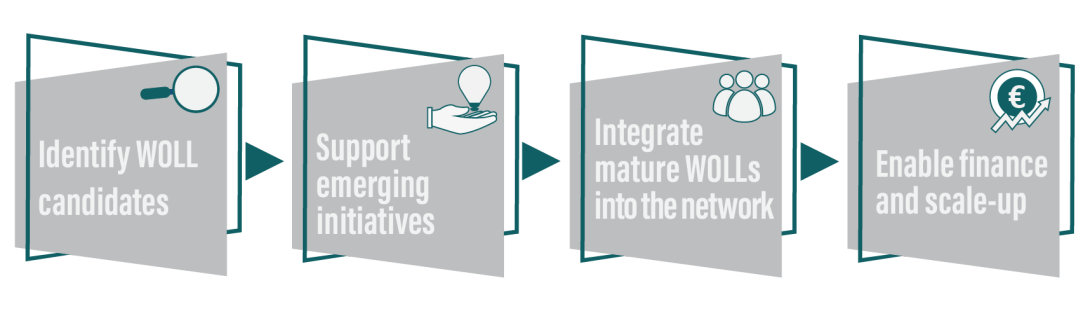
Learn more about "Demonstration of Innovation" Activities (Pillar D) link here |
What are the benefits to be/become a WOLL?
Becoming a WOLL is not just a label. It provides a practical framework to move from pilots to sustained territorial impact, through long-term collaboration, learning and iteration
Key benefits highlighted across the resources include:
- Real impact in context: tackling local “wicked” water challenges with practical, measurable outcomes and a long-term horizon.
- Stronger partnerships and shared learning via the Water4All WOLL community (peer exchange, shared practices, collaboration).
- Improved funding readiness: clearer vision/structure increases attractiveness for EU, national and private funding; WOLL recognition can improve competitiveness for calls focused on demonstration and replication.
- Innovation beyond technology: real-life testing of high-TRL solutions, plus social, regulatory and governance innovation (user perspective and acceptance).
- European visibility and credibility through inclusion in the Atlas of WOLLs, positioning a lab among recognised innovation ecosystems.
- Access to shared tools and methodologies (assessment tools, platforms, best practices) to accelerate uptake and avoid duplication.
- Policy acceleration: WOLLs operate as more than demo sites, producing evidence that can feed into EU policy processes and act as a sandbox for regulatory learning.
- Trust and stakeholder commitment strengthened by a recognised European framework.
How Pillar D supports WOLLs?
Water4All WOLLs
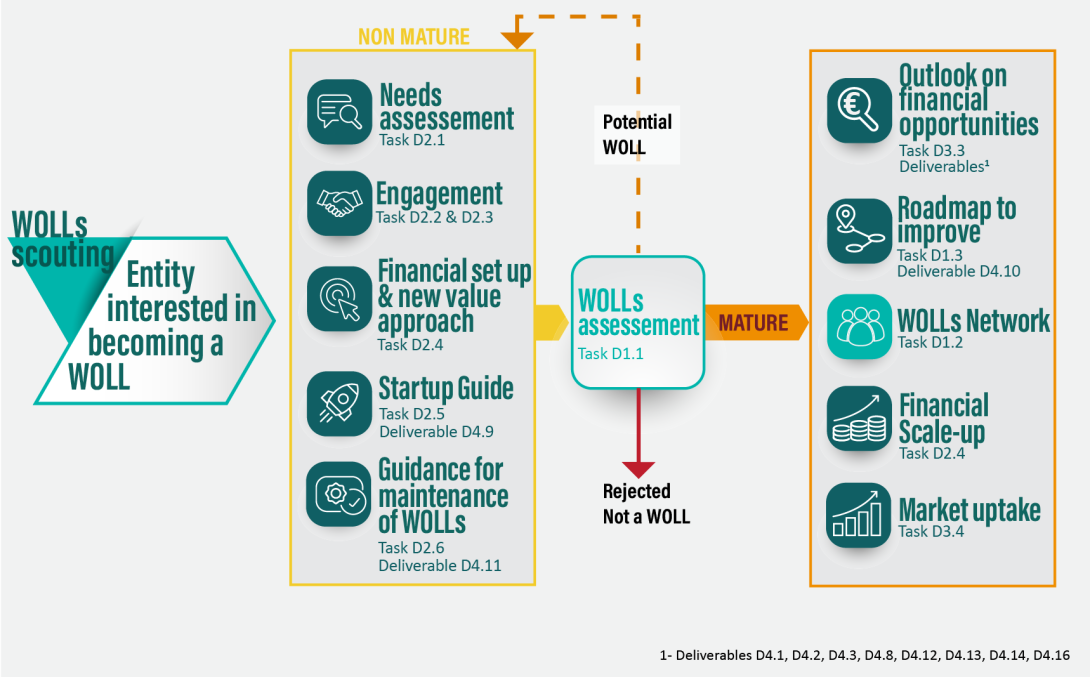
The process starts with scouting entities interested in becoming WOLLs (Task D1). They can apply directly for assessment or follow a preparation pathway supported by Task D2. Task D2 acts as an “incubator”: it increases maturity through needs analysis, stakeholder mobilisation, value propositions, structured support and practical guidance (guides/action plans). When ready, the candidate WOLL applies and is assessed through a structured tool.
Outcomes are either:
-
(i) recognition as a mature WOLL & inclusion in the Water4All Atlas and Network, or
-
(ii) tailored feedback and the option to re-apply after improvements.
Once recognised, WOLLs are integrated into Task D1’s Atlas and Network and engaged in peer exchange and clustering activities to reduce barriers and accelerate uptake. Through Task D3, WOLLs are supported in moving from demonstration to adoption via readiness assessment, business modelling, matchmaking and access-to-funding intelligence.